
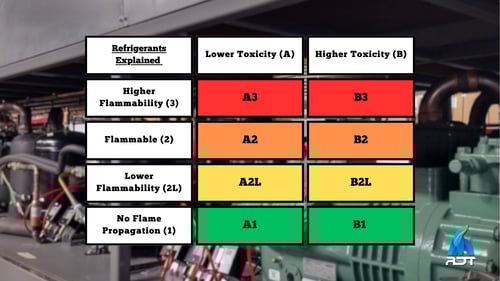
Quick Answer: Refrigerants are classified by ASHRAE based on toxicity and flammability: A1 refrigerants are non-toxic an...
A2L Resources: Next-Gen Refrigeration
The transition to A2L refrigerants is changing system design, safety requirements, and code compliance. This page provides resources, FAQs, and technical guidance for operators, contractors, and consultants.
EPA Announces Revisions to 2023 Technology Transitions Rule
5/26/2026
On May 21, 2026, the U.S. Environmental Protection Agency announced revisions to its 2023 Technology Transitions Rule affecting compliance timelines for certain commercial refrigeration applications.
Under the revised rule, interim compliance relief extends the use of higher-GWP refrigerants in certain subsectors through January 1, 2032, while the long-term transition to lower-GWP refrigerants remains in place. For affected applications, this change may allow continued use of refrigerants such as R-448A during the interim period, depending on the specific subsector and system configuration.
The final rule was published in the Federal Register on May 26, 2026, and becomes effective July 27, 2026. It can be located by searching EPA docket number EPA-HQ-OAR-2025-0005 or Federal Register document number 2026-10387.
At RDT, we remain aligned with the long-term direction toward lower-GWP refrigerants and will continue supporting customers through that transition. At the same time, if your project needs to move forward with an A1 refrigerant under the revised timeline, our NextGen platform is designed to support either path using the same core platform architecture. This gives customers flexibility to proceed based on project needs, regulatory strategy, and timing. If you would like to discuss how this change affects your project or whether an A1 option is the right fit, please contact your Project Manager and we will work with you on the best path forward.
RDT will keep this A2L Resource Hub updated as new details emerge so operators and partners have a clear and informed path forward.
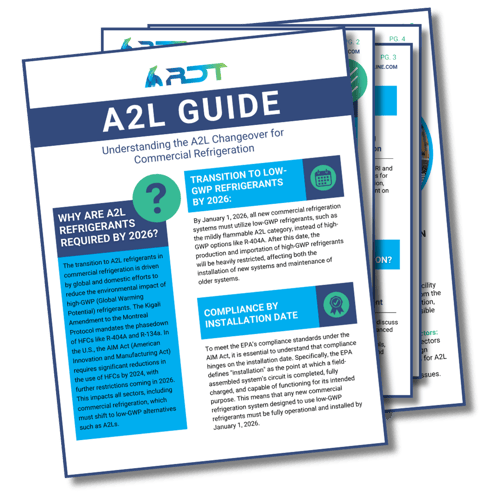
A2L Refrigerant Transition Guide
The A2L timeline has changed, but the industry transition is already underway. Our updated A2L Refrigerant Transition Guide reflects the latest EPA regulatory changes and provides practical guidance to help you plan with confidence for the January 1, 2032 compliance deadline.
WHAT'S IN THE GUIDE?

Future-Proof Plan
Stay ahead of industry trends and position your business for long-term success in the evolving refrigeration landscape.

Regulation Timeline
Clear timeline of EPA regulations and deadlines for A2L adoption.

Bonus: Checklist
Unlock the power of preparedness with our exclusive checklist – your roadmap to A2L compliance success!
Frequently Asked Questions About A2L Refrigeration
GENERAL QUESTIONS
Why do I not see the compressor horsepower rating on the refrigeration drawing?
The compressor manufacturer has been moving away from horsepower ratings for a few years now. Horsepower ratings are being phased out because they don’t accurately represent how a compressor performs. Horsepower only shows the motor’s input power, not the cooling capacity of the compressor. With newer efficiency standards and the shift to A2L refrigerants, compressors are now rated by actual performance metrics—such as BTU capacity, COP, and AWEF, which give a much clearer picture of how the equipment will operate in the field.
Can we still get an A1 refrigeration system?
Yes, however, they are exclusively for PARTIAL replacement systems. Example: your customer wants to replace either the condensing unit or evaporators, NOT BOTH. If both need to be replaced, then an A2L system will have to be quoted.
Why doesn’t the refrigeration rack nomenclature match what was specified?
With the A2L transition, all RDT and Polarcraft equipment required an update to the rack nomenclature that identifies the new model equipment.
Why doesn’t the evaporator model match what was specified?
Along with the A2L transition, RDT made the decision to change evaporator suppliers, thus causing the model discrepancy. This change allows full integration with our Eco-Smart control platform and the system architecture used in our current refrigeration designs. The evaporator provided is engineered to meet or exceed the performance specifications of the originally selected evaporator and is fully compatible with the specified refrigeration system.
INDOOR REFRIGERATION SYSTEM-SPECIFIC QUESTIONS
Does RDT offer indoor refrigeration systems that are air-cooled or water-cooled?
Yes, RDT offers both air-cooled and water-cooled refrigeration systems for indoor installation. However, there have been some adjustments made, which include, but are not limited to, factory installed stainless-steel housing and a field-installed refrigerant detection sensor kit.
Is the refrigeration system designed in accordance with ASHRAE 15?
Yes, the refrigeration system is designed in accordance with the ASHRAE 15 standard. However, ASHRAE 15 also focuses on how refrigeration systems are installed. There are calculations and code compliance requirements determined by the projects professional engineer (PE) to confirm that the installation adheres to the standard.
Are there ventilation requirements for the refrigeration system?
This will be determined by the PE on the project. In an effort to help maintain compliance, RDT provides all indoor systems with a refrigerant detection sensor capable of sending out a signal via dry contacts to whatever the PE determines is necessary.
ASHRAE 15 classifies various occupancies, which affect several sections of that standard. Who determines which occupancy is correct for any given location?
The architect of record or the building inspector would typically determine this classification.
ADDITIONAL QUESTIONS
What is the new EPA Proposed Rule on A2L?
Explore our continually updated blog for the latest regulatory insights.
How are A2L systems different from traditional refrigeration systems?
A2L systems are engineered with additional safety, ventilation, and leak detection measures to account for the mild flammability of the refrigerant. These design differences ensure compliance with updated safety standards like UL 60335-2-89 and ASHRAE 15.
Key Differences in A2L Systems
1. Leak Detection Systems
Required in most applications using A2Ls
Monitors for refrigerant leaks in enclosed spaces
Automatically triggers alarms or system shutdown if thresholds are exceeded
2. Ventilation or Airflow Management
May require mechanical ventilation in equipment rooms or confined spaces
Prevents refrigerant concentrations from reaching flammable levels
3. Charge Size Limits
Subject to strict maximum charge amounts based on room size, application, and presence of leak detection
System design must account for these limits to stay compliant
4. Spark-Free Electrical Components
Components in areas where refrigerant may accumulate must be ignition-protected or spark-free
5. Safety Control Logic
Built-in logic shuts down compressors and activates ventilation systems automatically in the event of a leak
What are A2L refrigerants? Why are they important?
A2L refrigerants are low-GWP (Global Warming Potential), mildly flammable alternatives to older refrigerants like R-404A. They are essential for meeting EPA and AIM Act regulations taking effect January 1, 2026.
💡 Want to understand how this regulation impacts your operation?
[Download our full A2L Transition Guide]
When is the EPA’s A2L refrigerant deadline?
Deadline: January 1, 2026
All new refrigeration systems must use compliant, low-GWP refrigerants like A2Ls by this date. Compliance is based on the installation date, not the purchase date.
📅 Need help planning your timeline?
[Grab the checklist in our free guide]
Can I retrofit my existing refrigeration systems to use A2Ls?
In most cases, no. Retrofitting is not allowed due to pressure and flammability differences. A full system replacement is usually required.
🛠 Not sure whether to replace or upgrade?
[Get expert advice in our A2L Transition Guide]
Are there safety considerations for A2L refrigerants?
A2L systems require:
Proper ventilation and airflow controls
Certified leak detection systems
Tools and equipment rated for use with flammable refrigerants
🧯 Explore our safety checklist in the full guide
[See the checklist]
Will switching to A2L refrigerants save energy or cost more?
While upfront costs may be higher, A2L systems often deliver 5–10% energy savings compared to legacy HFC systems—providing a long-term return on investment.
⚡ Explore the energy efficiency comparison
[Download the guide]
How can I prepare for supply chain delays ahead of the 2026 deadline?
Start sourcing compliant equipment early
Build relationships with trusted suppliers
Align early with inspectors and insurance providers
📦 Our guide walks you through every prep step
[Get the planning guide]
What codes or standards apply?
ASHRAE 15, UL 60335-2-89, and applicable local mechanical and fire codes.
Are there any installation differences compared to A1 refrigerants?
Yes. Most A2L installations will include:
Refrigerant shut-off valves in the suction and liquid lines, installed outside walk-ins
Control via evaporator controller with leak detection sensors
Possible requirements for fire-rated shafts or ventilation systems
Always refer to local building, mechanical, and fire codes along with ASHRAE 15.
Do servicers need special tools to work on A2L equipment?
Yes. Tools must be certified for flammable refrigerants:
Recovery machines, vacuum pumps, hoses, and gauges must be A2L-rated
Spark-proof tools are often required
Open flames or ignition sources must be avoided during service
Will A2L refrigerants require new components?
Yes. A2L-compliant systems require:
Specially designed compressors, condensers, and expansion valves
Electrical components (e.g., contactors, pressure switches, relays, controllers) rated for A2L compatibility
RELATED BLOGS
The refrigeration industry continues to change as environmental regulations push toward lower-GWP refrigerants. In early...
As environmental concerns and regulations evolve, businesses must stay informed about new policies and technologies. One...