Refrigeration systems rarely fail without warning. Performance erodes gradually when routine checks fall behind. Coils collect debris, airflow weakens, sensors drift out of calibration, and compressors compensate by working harder. Refrigeration maintenance planning prevents those slow failures by setting consistent inspections that keep systems operating within normal limits.
Operators who rely on reactive service calls often repeat the same cycle: a temperature fluctuation occurs, an emergency service call is made, and operations stall while repairs are underway. A structured maintenance plan breaks that routine by identifying problems early and correcting them before they affect food safety, efficiency, or equipment lifespan.
Why Does Refrigeration Maintenance Planning Matter?
Commercial refrigeration operates continuously under demanding conditions. Compressors cycle hundreds of times each week while fans move air across evaporator and condenser coils to remove heat from storage spaces.
Without structured refrigeration maintenance planning, three problems typically develop:
- Restricted airflow from dirty coils or obstructed fans
- Compressor strain caused by improper refrigerant levels or rising heat load
- System inefficiency from inaccurate sensors or poorly configured defrost cycles
Each issue develops slowly. When routine inspections slip, those small performance changes accumulate until the system loses stability.
A consistent maintenance plan keeps those conditions from escalating.
Core Tasks in a Preventive Maintenance Plan
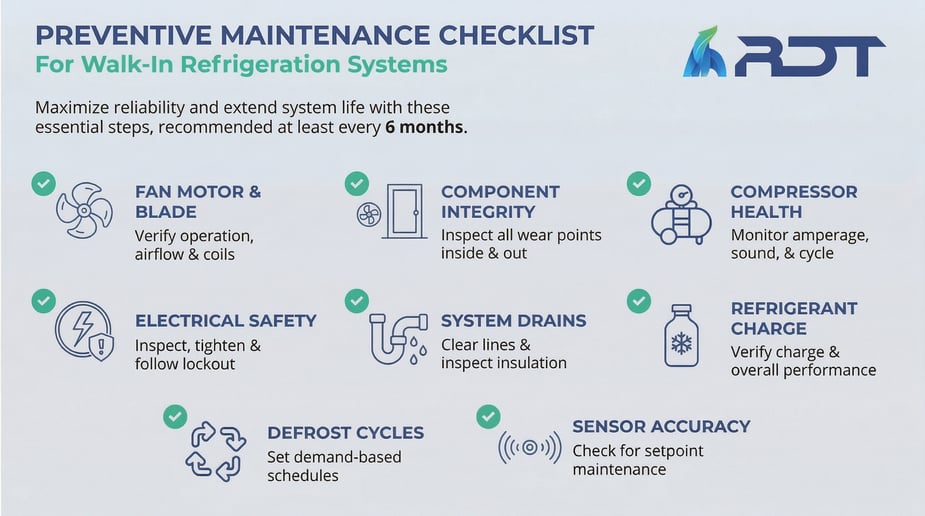
Effective refrigeration maintenance planning focuses on routine inspections that verify system performance and reveal early warning signs.
Airflow and Coil Condition
Airflow drives refrigeration performance. Fan motors must move air consistently across evaporator and condenser coils so the system can remove heat efficiently.
Maintenance inspections confirm that fan motors operate correctly and that blades remain free of debris or damage. Technicians also inspect evaporator and condenser coils for buildup or airflow restrictions that reduce system efficiency.
Compressor Performance
A compressor under stress doesn't always announce itself. Changes in amperage draw, sound, vibration patterns, oil condition, or cycling behavior often surface before a hard failure, but only if someone is checking.
Electrical Connections and System Components
Loose electrical connections can create intermittent faults or unstable system operation. Regular inspections verify that wiring and terminals remain secure. Technicians also review surrounding system components such as door hardware, gaskets, heaters, and controls to ensure the refrigeration system functions as a balanced whole.
Checking Drain Lines
A blocked condensate drain is easy to overlook and slow to cause visible damage, until ice forms or water pools where it shouldn't. Routine maintenance includes clearing and flushing these drains.
Refrigerant Line Inspections
Refrigerant lines play a direct role in system efficiency and stability. Degraded insulation can introduce unwanted heat gain, reducing capacity and increasing the compressor's workload.
Loose connections at fittings can also cause refrigerant and oil loss, leading to performance issues that often go unnoticed until system stability declines.
Routine inspections should confirm that insulation remains intact and that all connections stay secure. Maintaining proper insulation and tight connections supports consistent system control, protects equipment longevity, and prevents condensation.
Refrigerant Levels and Sensor Accuracy
Proper refrigerant levels allow compressors to maintain stable temperatures without excessive strain. Maintenance checks confirm that the refrigerant charge aligns with operating conditions. Sensor accuracy also matters. Thermistors and transducers must provide accurate readings to maintain the correct temperature setpoints.
Creating a Maintenance Rhythm
Routine inspections (about every six months) provide a practical rhythm for most commercial kitchens. Regular reviews allow technicians to evaluate airflow, refrigeration performance, and system balance before small issues grow into operational problems.
A structured maintenance schedule also produces documentation that helps technicians track performance trends over time. That record improves troubleshooting and ensures maintenance tasks occur consistently rather than reactively.
Refrigeration maintenance planning ultimately shifts system oversight from emergency response to proactive control. Operators gain more stable temperatures, fewer service disruptions, and longer equipment life.
FAQs About Refrigeration Maintenance Planning
How often should commercial refrigeration systems be inspected?
Most operations benefit from routine inspections. High-volume kitchens or systems under heavy load may require more frequent reviews to maintain airflow, refrigerant balance, and electrical stability.
What causes most refrigeration failures in restaurants?
Many failures originate from overlooked maintenance tasks. Dirty coils, restricted airflow, refrigerant imbalance, or inaccurate sensors gradually reduce system efficiency, eventually causing the equipment to struggle to maintain temperature.
What should be on a preventive refrigeration maintenance checklist?
A typical checklist includes airflow inspection, coil cleaning, compressor monitoring, electrical connection checks, drain line maintenance, refrigerant verification, and sensor accuracy testing. These inspections help technicians identify developing problems before they affect system reliability.
Start planning regular maintenance with our downloadable checklist: